IPCC – How not to compare temperatures

IPCC – How not to compare temperatures“. Anthony Watts posts Frank Lansner’s complaint on a favorite subject, alleged flaws in how the IPCC compares temperatures. Frank says that “there are numerous issues discussed intensely when it comes to IPCC-illustrations of historic temperatures” but other than the standard check list of groundless accusations and fabrications, his case really boils down to this: the IPCC is using too many temperature data sources and is averaging them!

So suddenly the problem isn’t lack of data, now it’s too much data. I also have to note with some astonishment that this is a complaint about how the IPCC illustrates historic temperature trends, not about the statistical trends that they are attempting to illustrate.

Quote of the week #33: What, no death spiral?

Quote of the week #33: What, no death spiral?” Anthony Watts tries to make hay over the fact that claimed predictions based on the sharp 2007 decline in Arctic ice extent haven’t been met, even though it’s still fairly low. Of course he has to ignore all the explanations that surround the quotes he has plucked in order to do that.

It’s physicist Dr. Joe Romm’s quote, which is actually a post title, from June 5th, 2009 that Anthony’s giggling over when considered in the light of another quote this week in The Sunday Times. I mean, there’s still ice up there!

NSIDC director Serreze explains the “death spiral” of Arctic ice, brushes off the “breathtaking ignorance” of blogs like WattsUpWithThat

Anthony somehow fails to detail Dr. Serreze’s explanation, which I would have thought should support the humor:

I said the north pole [meaning the local vicinity of the physical north pole, not the entire Arctic Ocean as Anthony chose to misrepresent it at the time – Ben] might melt out and I was not alone in making such speculation. It did not melt out and I got some flack for this. So be it. As for the “great recovery” of ice extent in 2008 heard in some circles, it was a  recovery from lowest (2007) to second lowest (2008).

The quote from Dr. Serreze this week that is entertaining Anthony is in a Sunday Times article by the notorious Jonathan Leake:

“In retrospect, the reactions to the 2007 melt were overstated. The lesson is that we must be more careful in not reading too much into one event”.

But he doesn’t mention Dr. Serreze’s statement that precedes it in the article.

“It has been a crazy winter with Arctic ice cover growing and very cold weather in northern Europe and eastern America all linked to this strongly negative Arctic Oscillation”

Or the article’s second paragraph:

A shift in the chilly winds across the Bering Sea over the past few months has caused thousands of square miles of ocean to freeze.

Perhaps there’s a zinger at the end or the article? Nope:

“On current trends it will still become ice-free in summer by around 2060.”

Anthony might want to wait until the definitive September minimum has been recorded before crowing, although he may be trying to get in there before the record proves him wrong.

I’m glad to hear though that he is now promoting long-term trends as the only relevant climate change evidence. Or is it just momentarily convenient?

Spiegel does 8 part series on current state of climate research

Spiegel does 8 part series on current state of climate research“. Anthony Watts tells us about this Spiegel Online article series that ” features Steve McIntyre prominently, and [is] well worth the read.”

The series starts with an already out-dated credulous rehash of the Climategate “scandal”. I guess it is a “worth the read” if you want to return to the time when wishful thinking could allow denialists to think that Climategate was merely a baseless political attack and not a completely rejected baseless political attack.

The remaining articles are a weakly argued denialist gruel of innuendo and mischaracterization (“alarmists” and the “levelheaded”) that heavily and uncritically quotes denialist pundits and “researchers”. Entertaining perhaps, but neither accurate nor insightful. Too bad.

If Global Warming Kills Us, Blame the Weatherman?

If Global Warming Kills Us, Blame the Weatherman?” Anthony Watts tries to spin a copy-and-pasted BNET article about George Mason University’s recent study of TV Weathercasters with his own newly-minted ‘maxim’: “Climate doesn’t kill people, weather does.

Just six words, but he still manages to get it wrong. I’d like to hear Anthony actually explain that one.

Science at work?

The gist of the article is that TV Weathercasters are the most visible and (sadly) trusted “scientific” information source for most Americans, but they are poorly qualified and predisposed to resist evidence of Global Warming. 27% of TV Weathercasters actually think Global Warming is “a scam”! The credentials and actions of dear Anthony Watts make him a poster boy for this assessment…

NASA Data Worse Than Climate-Gate Data, GISS Admits

NASA Data Worse Than Climate-Gate Data, GISS Admits“. The latest scientific analysis Anthony Watts has copied-and-pasted is… a Fox News article! This is really scraping the bottom of the barrel.

Blake Snow of FOXNews.com reports as an admission of inferiority a NASA scientist’s assessment of the strengths and weaknesses of the different global surface temperature analyses. He also presents as definitive the opinion of Christopher Horner, a ‘senior fellow’ from the right-wing Competitive Enterprise Institute, that “three out of the four temperature data sets stink”. When another ‘senior fellow’ this time at the right-wing Heartland Institute, James M. Taylor, is quoted next and the article ends with our own Anthony’s unchallenged arm-waving about the “quality” of surface stations, you know the fix is in. “Fair & Balanced”, eh?

The only hint of reality comes from Dr. Jeff Masters at Weather Underground: “It would be nice if we had more global stations to enable the groups to do independent estimates using completely different raw data, but we don’t have that luxury”.

The real story? Climatologists have a limited number of long-duration surface temperature stations available to them. They use as many of those stations as possible. It’s a fundamental logical fact that they will all start with the same raw data. The differences will be in how they select representative stations from the entire data set and how they extrapolate from those stations.

As a final thought, I have to draw attention to the use of “accuracy” as the sole valid assessment of a temperature data set. Data can be accurate (very close to a true reading) but not as useful (doesn’t reflect the actual conditions over a wider area). The fundamental difference between the interpreted surface temperature data sets is that some are optimized for accuracy, some for global representativeness. There are good reasons for each approach. There are also good reasons why denialists try to define the argument on such narrow and misleading points.

Quote of the week #32 – hockeying up a zinger

Quote of the week #32 – hockeying up a zinger“. Anthony Watts offers up a cherry-picked interview excerpt from climatologist Dr. Michael Mann (the full interview on The Morning Call is good reading):

[Anthony dropped this part: I would say that all good scientists are skeptics. Many who deny the existence of climate change I would not call skeptics, because their skepticism is one-sided.] “I would call them contrarians or, frankly in some cases, climate change deniers,” he said. “I’m a skeptic. When I see a scientific claim being made, I want to see it subject to scrutiny and validation.”

Scientists aren’t allowed to describe themselves as “skeptical!” That’s reserved for Anthony!

Instead of telling others to look in the mirror perhaps he should crack open a book (or a web page). Dictionary.com defines skeptic and offers this illuminating quote (italics mine):

Skeptic does not mean him who doubts, but him who investigates or researches as opposed to him who asserts and thinks that he has found. [Miguel de Unamuno, “Essays and Soliloquies,” 1924]

Sounds like the normal approach of scientists to me. And their “skepticism” has led to some entertaining debunking of statements made by Anthony and his associates.

What “skeptical” post by Anthony would be complete without a bit of Climategate innuendo and a suggestion to readers that they pester a journalist? Check.

England’s Five Year Climate Forecast Cycle

England’s Five Year Climate Forecast Cycle“. Steven Goddard has England on his mind these days. He’s irritated that the Met Office’s predictions have changed. Is there anything more galling than climate predictions changing to incorporate new theories or more refined understandings? I didn’t think so.

The single day that the UK was covered in snow.

Why Joe Bastardi sees red: A look at Sea Ice and GISTEMP and starting choices

Why Joe Bastardi sees red: A look at Sea Ice and GISTEMP and starting choices“. Groan. Anthony Watts is promoting another “simple question” from Joe Bastardi: “If it’s warmer than normal, you should not have an increase in ice.” Joe, the chart is of temperature anomalies not temperature. So even though its warmer in the arctic that doesn’t mean that it’s warm. Joe Romm’s post on Climate Progress takes this on more fully – “Accuweather’s “expert long-range forecaster” Joe Bastardi has now firmly established himself as the least informed, most anti-scientific meteorologist in the world.

GISS surface temperature anomaly, Dec-Jan-Feb 2010.

Naturally Anthony’s totally onboard with Joe Bastardi’s dark hints about conspiracy theories and “magical readjustment”. Also, he claims that using red to denote positive temperature anomalies is deceptive.

Anthony also posts a blizzard of charts which boil down to an exercise in picking a baseline date at a time when some of the global warming has already occurred to reduce the apparent temperature anomaly. Why didn’t he just set today as the baseline and declare NO temperature anomaly? If you’re going to misuse data might as well go all-in.

He the cooly admits that “anomalies can show anything you want based of choosing the base period.” We know, Anthony, you just gave us a master-class in biased analysis!

Loehle on Hoffman et al and CO2 trajectories

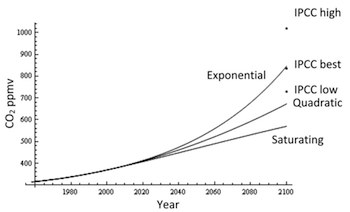
Loehle on Hoffman et al and CO2 trajectories” Anthony Watts learns that the “National Council for Air and Stream Improvement, Inc.” forestry lobby group has funded a paper by Craig Loehle in Atmospheric Environment, a ‘low-impact‘ air pollution journal.

Loehle whips up some arbitrary equations that seem to be equally good at matching historical atmospheric CO2 concentrations as the IPCC’s, so clearly nothing can be concluded from the IPCC’s ‘scary’ predictions.

Simple equations make such smooth curves! (Loehle, 2010. Fig. 3)

The IPCC’s predictions based on physical and chemical atmospheric science. That’s more relevant than pulling numbers out of thin air and pretending you’ve studied something in its scientific context. This is looks like statistical game-playing to me.

The Guardian sees the light on wind driven Arctic ice loss

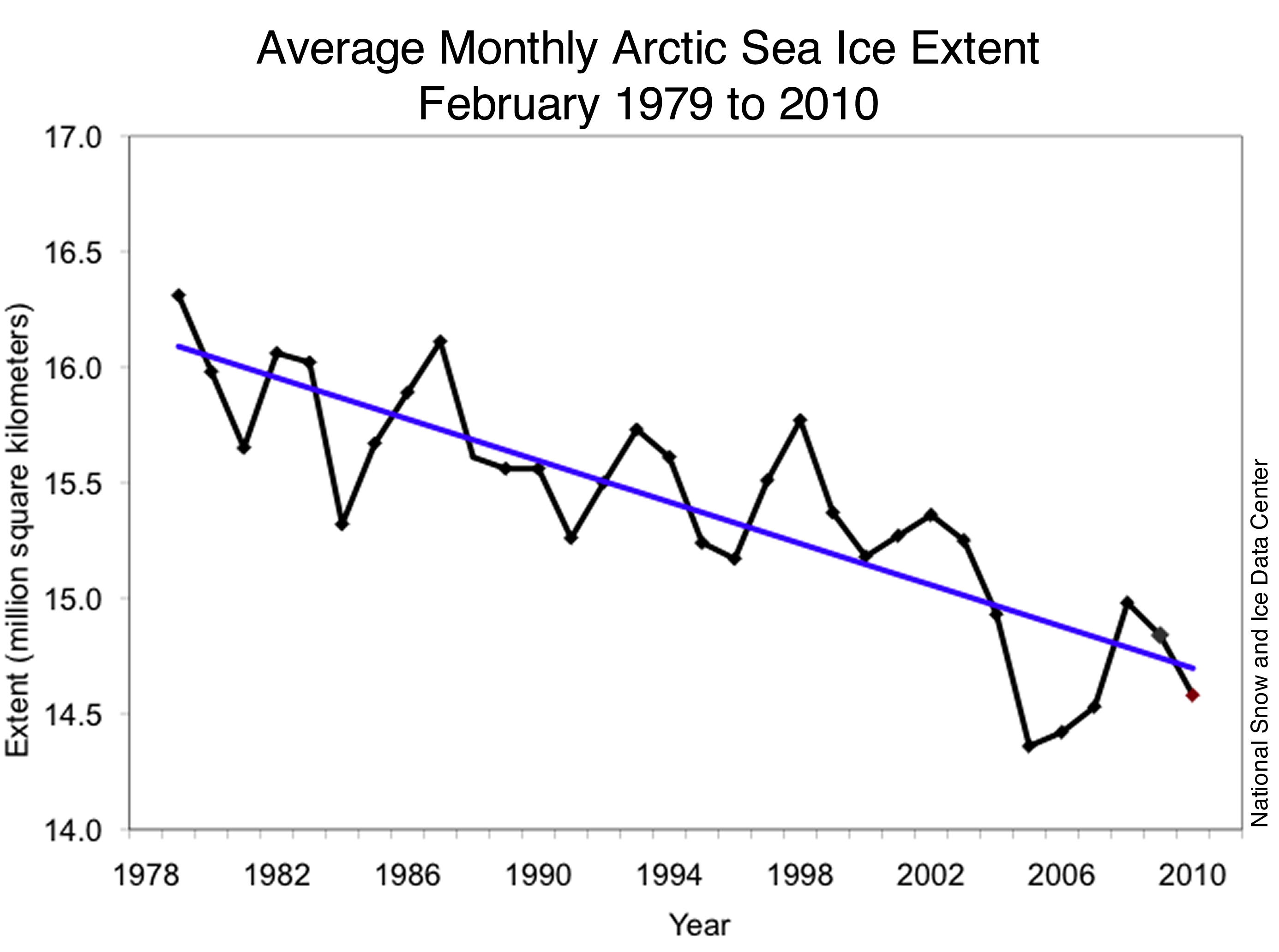
The Guardian sees the light on wind driven Arctic ice loss“. As Anthony Watts knows, newspapers are where science happens. Anthony seems to think that there’s a grudging admission about Arctic ice underway at The Guardian, at least partly driven by his own searing scrutiny. The article is reporting findings from the US National Snow and Ice Data Center.

Monthly February ice extent, 1979 - 2010 shows a 2.9% decline per decade. Credit: National Snow and Ice Data Center.

This quote from Anthony’s copy-and-paste of the Guardian article would be enlightening if he paused to reflect (italics mine):

Ice blown out of the region by Arctic winds can explain around one-third of the steep downward trend in sea ice extent in the region since 1979.

What’s up with the other two-thirds, eh? I guess as long as Anthony can include the word “doubt” he thinks his job is done.