Faint young sun paradox explained by Stanford – greenhouse effect not involved

Faint young sun paradox explained by Stanford – greenhouse effect not involved“. Anthony Watts wants us to know the two billion years ago, the Greenhouse effect was not responsible for keeping the Earth warm in spite of the Sun’s lower energy output. Therefore, Global Warming is a scam.

This is actually a Stanford University press release about a study of ancient banded iron formations (which are fascinating sediments). Apparently a “vast ocean” managed to absorb and retain enough heat to stay liquid.

As always, Anthony the ‘critical thinker’ jumps straight in because it can be spun towards denialist beliefs. I’m not so sure that I accept this yet, but it’s interesting science. Were the early oceans really that much larger than present?

Modeling the big melt

Modeling the big melt“. Anthony Watts reports that Minnesotans are going to love global warming. We know this because of a press release about a Climate Central interactive climate page that Anthony found on Eurekalert and pasted into his blog.

Well the joy of Minnesotans in the year 2090 is postulated and of course is excised from any complaints about probable drought conditions.

Sunny days ahead!

Such scientific nuance from The Great Explainer-Awayer.

Skating on the Other Side of the Ice

Skating on the Other Side of the Ice“. Willis Eschenbach returns with an unfounded claim that “for reasons which are not well understood, when one pole warms, the other pole cools.” This is used to justify a belief that sea ice changes balance out between the polar regions (they don’t). Unsurprisingly, the focus is on less definitive sea ice extent, with no mention of the important documented changes in sea ice volume.

The Arctic and Antarctic sea ice environments have substantially different characteristics, so even suggesting that their responses are linked is naïve (or disingenuous). The Arctic sea ice is thinner and partly land-locked. The Antarctic sea ice is thicker, partly driven by glacier outflow, and exposed to ocean circulation.

Why does Willis think the sea ice trends balance out? “The short answer is that we don’t know“. He does offer some suggestions based on an unproven cosmic ray theory or “eddies” in the ocean circulation patterns. Ah. So the post offers neither evidence nor explanation.

The insight that Willis offers on global sea ice trends is…

Nothing.

Energy Star-t Your Engines

Energy Star-t Your Engines“. Anthony Watts reports that the US Energy Star certification process can be manipulated! There is “massive fraud in the EPA/DOE Energy Star Program“! The New York Times says so!

Actually no, just Anthony says so. In fact, Congressional investigators found that they could apply for Energy Star certifications for 15 fictitious devices (5 others were rejected), but have no evidence that widespread misrepresentation has occurred. See the difference?

This of course means that there is no global warming. And if there is, its hopeless trying to do anything about it so lets oppose oppressive governmental regulation.

Rewriting the decline

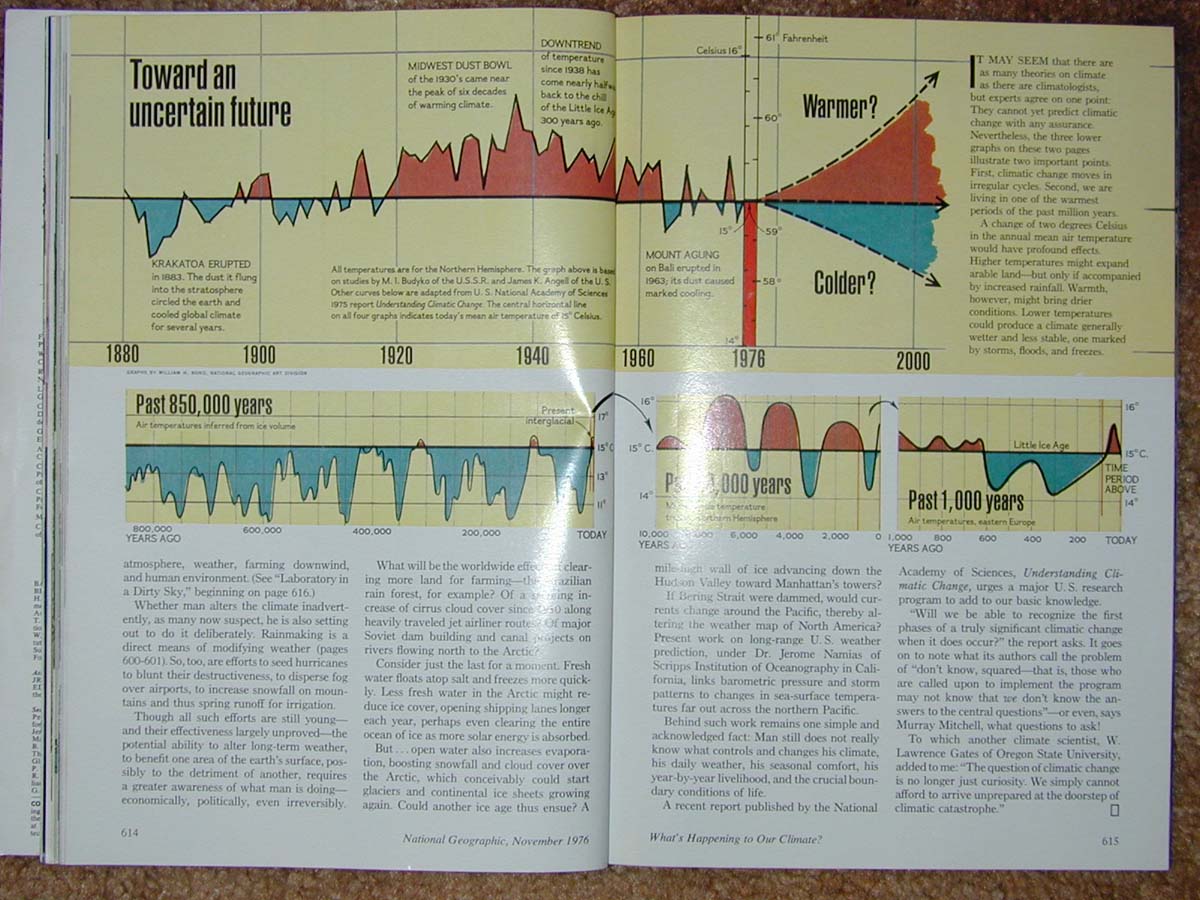
Rewriting the decline“. Anthony Watts’ friends have been down in their basement and found a 1976 issue of National Geographic with a temperature history chart of North America that looks different from current global temperature histories! Could there really be a decline in temperatures since the 1960’s that evil climatologists have tried to hide from us?

After admitting that “the global records are not available to check, it’s impossible to know how accurate or not this graph is” they proceed to make the usual speculations and accusations ( including the suitably Orwellian “history has been rewritten”) based largely on a digital photo of a squished magazine illustration. (The version I post here includes more of the original figure than the denialists revealed.)

Art illustrations as scientific evidence. Note: chart in the lower left, excluded from the discussion, is apparently NOT evidence.

The j’accuse comes pretty quick: “the data had been adjusted (surprise)“, backed by this supporting evidence:

But, as usual, the adjustments were in favor of the Big Scare Campaign, and the reasons and the original data are not easy to find.

So in other words, they have no idea why the modern, global, chart differs.

Anthony compounds this ignorance as usual by failing to understand the term “accuracy”, but he really got my attention with his sudden conversion to dendrochronology.

Many tree rings showed a decline after 1960 that didn’t “concur” with the surface records. Perhaps these tree rings agree with the surface records as recorded at the time, rather than as adjusted post hoc?  Perhaps the decline in the tree rings that Phil Jones worked to hide was not so much a divergence from reality, but instead was slightly more real than the surface-UHI-cherry-picked-and-poorly-sited records??

Anthony, do you really think that the temperature records were maliciously altered around the world to suit an implied political agenda? And that now we should trust the innocent, uncorrupted, tree rings?

Response to Ravetz and post-normal science

Response to Ravetz and post-normal science“. Professor Jerome Ravetz’s ‘post-normal science’ posts on Anthony Watts’ blog have elicited another obtuse response, this time from professor Jaap Hanekamp (advisor to several denialist/libertarian entities such as Heidelberg Appeal Nederland and the Committee For A Constructive Tomorrow).

His conclusions (I think)? Politics restrict the areas of study, CO2‘s role as the primary cause of climate change is a political simplification, the push for regulation of CO2 is “undemocratic” repression, deception is practiced and justified by climatologists because of the perceived environmental risks, the scientific “majority” are hindering relevant theories, the worldview of climatologists is distorting their science, climatologists are arrogant.

Dr. Hanekamp flash of insight is this:

theories should be accepted only in the light of considerations that involve transparent and reproducible empirical data, other (accepted) theories, and cognitive epistemic values such as consistency, simplicity, transparency, and descriptive, explicatory and predictive power. Worldview (political and ideological) considerations, but also appeals to authority, consequences, force, and popularity – to name some of the argumentation fallacies – are illegitimate ways of deciding between theories.

Welcome to “Science” Jaap! This is how it is already done. The problem we face is denialist resistance to climatology because they find the implications politically unacceptable. Your 5,200 word departure from reality is a collection of accusations and mischaracterizations that end in a demand for current scientific practices to continue!

Dr. Hanekamp does have some useful admissions to make though (Anthony Watts take note):

Bloggers have a similar obligation as scientific experts, at least if they want to enter or be part of the debate with the focus on scientific content instead of rhetorical contentment.

Royal Statistical Society backs “models and data in the public domain”

Royal Statistical Society backs “models and data in the public domain”. See the submissions by the Royal Chemical Society and Institute of Physics. Same general statement, same biased interpretation by Anthony Watts as damning.

There are, of course, passages in the Royal Statistical Society’s filing that don’t suit Anthony’s bias. This one gets to the nub of things:

The ability to verify models using publicly available data is regarded as being of much greater importance than the specific content of email exchanges between researchers.

The data is almost entirely publicly available already. The whole controversy boils down to quote-mining personal e-mails for rude comments.

This one’s also good, as it addresses denialist harassment:

It is also clearly unreasonable to require that any given scientist having published some research is then condemned to answer each and every question that might possibly arise from it.

Interestingly, the Royal Statistical Society doesn’t seem to have any concerns about the word “trick” that is so angrily discussed in denialist circles.

Royal Society of Chemistry backs sharing of data in contrast to Jones “standard practice” statement

Royal Society of Chemistry backs sharing of data in contrast to Jones “standard practice” statement“. The Royal Society of Chemistry makes a general mom-and-apple pie statement in response to a request from the Parliamentary inquiry similar to the Institute of Physics just made. Anthony considers this another damning judgement. My translation: Yes, yes, t’s must be crossed and i’s must be dotted. Now leave us alone, you bitter letter-writing obsessive paranoids!

I do like this bit though (emphasis mine):

Authors generally protect their data until it has been peer-reviewed and published in a formal publication due to the competitive nature of research.

and this bit:

The issue of misinformation in the public domain must also be tackled. Just as the scientific community must be open with regard to their evidence base, those who disagree must also provide a clear and verifiable backing for their argument, if they wish their opinions to be given weight. When disagreements occur, the validity of the analysis must be established before credence can be given to any opinion.

2010-03-07 Update: I missed this enlightening excerpt from the RSC statement, but Rabbet Run didn’t.

Encouraging scientists to openly engage with the public can only be achieved if researchers are given the necessary backing in the face of any unfounded arguments against their work.

Sense and Sensitivity

Sense and Sensitivity“. Citizen-scientist Willis Eschenbach becomes an expert on insolation and tells us that because the geographic poles receive 24-hour sunlight in the summer they can somehow get hot. Then he uses his sudden scientific insight to make up some predictions and declare his ideas proven.

So, how are these values calculated? And those error bars look pretty massive.

Here are Willis’ Thunderstorm Thermostat Hypothesis predictions:

  1. Climate sensitivity is less near the equator than near the poles, because “the almost-daily afternoon emergence of cumulus and thunderstorms is primarily a tropical phenomenon.” (No evidence presented.)
  2. Climate sensitivity is less in latitude bands which are mostly ocean, because the “ocean warms more slowly”, “energy [is] going into evaporation” and “clouds and thunderstorms can form more easily” over water. (No evidence presented or physical explanation offered.)
  3. The “damping effect of the thunderstorms” and “increase in cloud albedo from increasing temperatures” means that “climate sensitivity would be much, much lower than the canonical IPCC climate sensitivity of 3°C from a doubling of CO2.” (No evidence presented or explanation offered.)
  4. “Given the stability of the earth’s climate, the sensitivity would be quite small, with a global average not far from zero”. (No evidence presented or explanation offered.)

Earth to Willis: Regardless of your naive speculations the IPCC’s 3°C climate sensitivity from a doubling of CO2 is based on empirical measurements that suggest a range of 2.0 – 4.5°C. It is highly improbable that the sensitivity is less than 1.5°C. You’ve been engaged in an enthusiastic exercise in self-delusion.

Archibald on stellar to climate linkage

Archibald on stellar to climate linkage“. Anthony Watts offers a guest post by Australian oil geologist David Archibald about how solar influence on the Earth’s climate and interaction with cosmic rays explains everything. Even though the sun’s influencing factors have been emphatically trending toward cooling and the actual Earth’s climate has been emphatically trending towards warming. Nice Google clip art research David, those charts sure are wiggly.

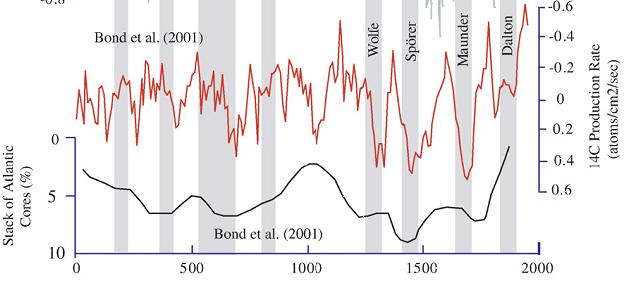
Why do those ‘conclusive’ patterns have such crappy correlation? Why are you using such indirect proxies and flipping them around so casually? And did the Little Ice Age really last right up until 1900?

Breaking news: the Little Ice Age was 500 years long!

David Archibald, a “scientist working in the fields of climate and cancer research” (emphasis mine) believes that the “more carbon dioxide you put into the atmosphere, the more you are helping all plants on the planet to grow” (no need to add emphasis). David Archibald is a crank in two completely different areas of science? Nice…