2010 – where does it fit in the warmest year list?

2010 – where does it fit in the warmest year list? Christmas Guest pudding from Geology Professor Dr. Don Easterbrook. Apparently 2010’s record temperature is “really much to do about nothing.” After-all, if you go back 10,000 years you can find plenty of warmer years. I guess the denialist leg-puller about only needing to look at the last 15 years is out of favor now that 2010 can’t still be brushed aside.

What strikes me in all of Easterbrook’s sloppy “data” is that, at a time when the Earth should now be following a pronounced cooling trend it is emphatically not. Wiggle your way out of that one, Professor.

There are enlightening insights into Easterbrook’s scholarship at Only In It For The Gold (Garbled Reasoning at WUWT) and Hot Topic (Easterbrook’s Wrong (Again)), but I’ll leave the technical criticism to this comment in the Watts Up With That post by “BillD”:

Where is peer review when you need it? This post conflates the global climate record with regional records for the US and Greenland. Then it fails to point out that “present” only goes up to 1905. Over the last 21 years, I have been the editor or reviewer for over 600 manuscripts submitted for publication in peer-reviewed scientific journals (I need to keep a record for my employer). I have to say that I have never seen a submitted manuscript with such blatant errors as in this post. Even submitting a manuscript such as this would be damaging to one’s career and would certainly cause the loss of all credibility with the journal’s editor and the reviewers if any (In most cases the editor peruses a manuscript to check it’s suitability for the journal and to decide on expert reviewers. These kinds of errors and misleading comparisons would almost certainly lead to rejection by the editor, without even sending the ms. out to reviewers).

Even Dave Springer, a Watts Up guest author, comments unhappily (emphasis mine):

The new guest author program, which include myself as one of those new guest authors, appears to have fostered a greater need for internal peer review before the articles are published. Anthony and Willis and guest authors like Spencer and Lindzen didn’t seem to need much in the way of peer review but with this new influx of guest authors the comments are now stuffed with repetitious exposure of errors in the articles.

Is Prof. Easterbrook really so sloppy? Or his he more concerned with finding a story that he can enjoy telling?

Do We Care if 2010 is the Warmist Year in History?

Do We Care if 2010 is the Warmist Year in History?. The new denialist talking point emerges! Who cares if 2010 was the warmest year ever? Ira Glickstein says (well, suggests) that it’s all because of lying corrupt climatologists making malicious adjustments anyway!

Keep talking about that, but remember to add a caveat like:

“What does this all mean? Is this evidence of wrongdoing? Incompetence? Not necessarily.”

A few years ago there was debate about whether 1998 or 1934 was the hottest year ever, but the climatologists made 1998 the hottest year with their evil adjustments! They’re probably doing it again.

Next problem.

Where Did I Put That Energy?

Where Did I Put That Energy? More Christmas Guest pudding. Willis Eschenbach is always good for a snort, but before I even caught up to this post he’d admitted a factor of 10 calculation error…

Willis is trying once more to misrepresent Kevin Trenberth’s “travesty“‘ statement that “we can not account for what is happening in the climate system” (he was talking about simple data collection issues, not that the evidence disproved Global Warming). This time he tries to include the oceans in his argument. Why not, eh? They do cover 71% of the Earth’s surface.

Willis’ complicated equation for solving the puzzle is ∆Q (change in energy added) = ∆U (change in energy lost) + ∆Ocean (change in energy in/out of ocean). He substitutes surface temperature “T” divided by the climate sensitivity “S” (conventionally estimated as 0.8) to get this: ∆Q = ∆T / 0.8  + ∆Ocean  (Joules/year). Nuanced, isn’t it?

As always, Willis’ only path to enlightenment is through crappy Excel charts. He theorizes (let’s be generous for a moment) that:

because energy cannot be created or destroyed. If we add extra energy to the system, it has to either leave the system via increased radiation or get stored in the ocean. There is no “lag” or “in the pipeline” possible.

This lets him assert that any discrepancy is proof that the mainstream climatologists are wrong. Handy that, although it doesn’t show any awareness of what Trenberth’s real concern was: that there were areas of the ocean that are inadequately monitored, with potentially unaccounted energy flows.

Still, Willis races on to his profound insight:

I make no hard claims about any of this, as I don’t know where the missing energy really is. I don’t even know if this is the missing energy that Trenberth was talking about. My theory is that the energy is not missing, but that Equation 2 is wrong. My hypothesis is that the earth responds to volcanoes and other forcing losses by cutting back on clouds and thunderstorms.

Sorry dude, a climate hypothesis isn’t something pulled out of your ass, it’s something that uses a real physical mechanism to accurately explain measured values. Changing thermodynamics to suit your interests doesn’t pass muster.

Confirmation of Solar forcing of the semi-annual variation of length-of-day

Confirmation of Solar forcing of the semi-annual variation of length-of-day. December 23rd gave us Anthony Watts’ first Christmas Guest, and Paul Vaughn (M.Sc.) served up a delightful slice of Dunning-Kruger pudding. There’s nothing a denialist likes more than a new and obscure correlation to (briefly) divert the conversation… Causation is for sissies.

Paul wants to show that Earth’s Length of Day is influenced by cosmic rays, which slightly affect atmospheric density. Hence, using the power of wishful thinking, all Global Warming is natural and will reverse itself. Eventually. Paul gives us lots of cluttered stock promoter-style charts, spreading a tiny proportional change over a full chart range. You’d think an analytical genius like, perhaps, Steve McIntyre would call him to task on it wouldn’t you?

Yes, atmospheric and oceanic angular momentum impacts Length of Day. Trivially. This influence, measured as being on the order of one millisecond out of 86,400,000 over a period of months, is significant? Try again. Cue the ignorant arguments about magnetic fields in the comments.

Sea Ice News #32 – Southern Comfort

Sea Ice News #32 – Southern Comfort. Anthony Watts tries to explain why he’s been avoiding the topic of Arctic Sea Ice. Apparently because the precipitous drop in Arctic Sea Ice, which Anthony is careful not to display until the end of his post, isn’t nearly as interesting as the statistically insignificant rise in Antarctic Sea Ice. Even though Arctic conditions are primarily affected temperature and Antarctic conditions are primarily affected by ocean currents.

Cue bold-faced muttering about “healthy skepticism”, hidden data (oops! it was there all along) and wounded references to nasty scientists making accusations of breathtaking denialist ignorance. Oh, and apparently Tamino’s takedown amuses Anthony.

Australia’s white summer, Monbiot’s red fury

Australia’s white summer, Monbiot’s red fury. Watt a surprise, Anthony Watts drawing our attention to a freak weather event in Australia. This must surely prove that there’s no Global Warming! Anthony also stretches his mental capacity to compare the size of Australia to America and to Europe. Anthony is mad that environmental reporter George Monbiot consulted “the kids at the Climate Rapid Response Team“, aka professional climate scientists, to understand this Australian weather. How dare he!

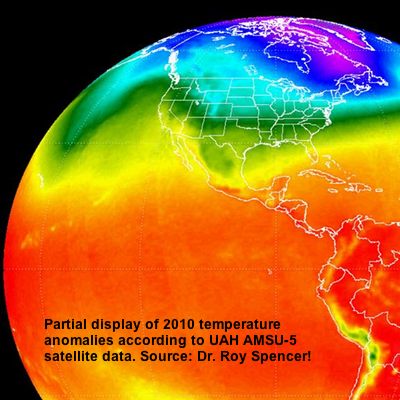
Don’t you know that if you cherry-pick a small enough smoothing radius you can make big holes appear in the global temperature data maps? I’m surprised that Anthony doesn’t try to claim that all smoothing is false and present a temperature data map with 99.9% “no data”.

Changing your color scheme to assign ‘bluer’ colors to warm temperatures also helps make things look ‘cooler’. Presumably Anthony thinks that every year those corrupt mainstream climatologists have been slightly changing their color schemes to look make the same temperatures look ‘redder’.


Hmmm... Dr. Spencer's map is pretty red. He must be in on the plot now too.


Anthony has to come up with something to distract from the fact that 2010 has proven the hottest year in the instrument record even with only a moderate El Niño influence. (Note: who cares about one year? That’s a denialist distraction. It’s the long-term trend that matters.)

Further more, we learn that the weather stations in remote Greenland communities are clearly affected by the urban heat island effect. Anthony’s speculation proves it! (Maybe this particular rant was a bit of nostalgia for the old days when Anthony regularly tried to get away with this UHI b.s.)

Is the warming in the 20th century extraordinary?

Is the warming in the 20th century extraordinary? Frank Lansner guest-posts on Anthony Watts blog, this time with a “proof” that all this warming is nothing to worry about.

You see, we’ve had natural periods of warming in the past and they never got much higher than where we’re at right now. So clearly it’s going to stop warming soon too, and amateur data plots prove it!

Squish anything together enough and you can hide whatever you want.

But weren’t all those earlier periods of warming caused by natural cyclic inputs over thousands of years? And isn’t this one caused by abrupt and open-ended human inputs? Not such a good bed-time story after-all, even though Anthony’s “skeptical” readers are rapt.

The Story Told by the Southern Oscillation Index

The Story Told by the Southern Oscillation Index. David Archibald guest-posts on Anthony Watts’ blog, trying to make the case that the Southern Oscillation Index, which supposedly influences the Pacific Ocean’s El Niño currents, proves that Global Warming is all just a natural wobble.

Except the “The Story” boils down to arm-waving over very noisy data (with a side reference to Climategate) and concludes with “for some as yet unknown reason.”

Now that’s blog science, Anthony-style…

Monckton’s Mexican Missive #2

Monckton’s Mexican Missive #2“. Denialist blowhard Lord Monckton, rattling around the UN climate conference in Cancun waiting for supplicants to seek out his guidance, provides another rambling “report” about how everyone at the Conference is stupid. And evil. And mean. And blindly “religious.” And demoralized. And conspiring. The list seems endless. Anthony Watts gives it all his seal of approval.

And yet this unsupported repetition of a wide list of debunked denialist claims and allegations of conspiracy, along with a random political broadsides and references to his dinner menu, are all we get from the leading “intellectual” of the denialist movement… What a train-wreck.

Monckton reaches his pinnacle of cleverness when he encourages people to call the “wicked” IPCC the “ipecac”. Oh, if we use the name of syrup of ipecac instead of their real name no one will take them seriously! They’ll just think of throwing up! Oh you are by far the cleverest guy in Grade Three and your readers are, tellingly, quivering with delight.

BBC “disappears” headline “Coldest December Day on record for some sites”

BBC “disappears” headline “Coldest December Day on record for some sites”. Oh. My. Dog. (Sorry, reading Anthony Watts’ blog makes me dyslexic sometimes.) A website changed an article headline! It is a climate conspiracy!

Anthony follows this revelation with some nit-picking over whether 2010 really will be a “dead heat” with 1998 for the hottest year on record. This requires ignoring the running averages that have always been used for comparison, mumbling about where the real “finish line” is, breaking out a magnifying glass and of course not discussing at all the fact that 1998 was hot because of a very strong El Niño effect while there is no comparable influence contributing to 2010’s results.

Ooh, an Emily Litella moment! After all that whining about the word “dead heat”, it turns out that the denialist’s favorite scientist Dr. Roy Spencer is the one that used it. Quoth Anthony; never mind.