GISS Polar Interpolation

GISS Polar Interpolation. Like the Wandering Albatross, Steven Goddard returns once more to complaining that because the NASA Goddard Institute for Space Studies (GISS) doesn’t have 5000 weather stations on the Arctic sea ice their global temperature analysis is a lie composed of “incorrect, fabricated data”. James Hansen even admits that !

Steven cherry-picks June 2010 from the Danish Meteorological Institute (DMI) model for comparison because it’s the only month he can use to “prove” that the Arctic is colder than GISS reports. Steven loathes any kind of “modeling” because they let scientists ‘manipulate the truth’, but the DMI model suits his purpose today so its OK I guess. The DMI model uses a different set of records and different assumptions, in particular with a cold bias due to inclusion of Arctic buoy readings, so naturally it gives a slightly different result. This is useful to Steven.

Daily mean temperature north of 80th northern parallel. Steven likes June 2010 here. It's the only month he can play games with. Source: DMI.

It’s always fun to work yourself up into a nice lather, but if data isn’t available scientists will try to find ways to compensate. It’s called research and it doesn’t involve playing games with Photoshop. Just because it suits Steven’s purpose doesn’t mean that, for example, rejecting the interpolation of temperature beyond 250 km is legitimate. GISS explains their choice clearly:

The correlation of temperature anomaly time series for neighboring stations was illustrated by Hansen and Lebedeff [1987] as a function of station separation for different latitude bands. The average correlation coefficient was shown to remain above 50 percent to distances of about 1200 km at most latitudes, but in the tropics the correlation falls to about 35 percent at station separation of 1200 km. The GISS analysis specifies the temperature anomaly at a given location as the weighted average of the anomalies for all stations located within 1200 km of that point, with the weight decreasing linearly from unity for a station located at that point to zero for stations located 1200 km or further from the point in question.

So what if there was a fatal flaw in the GISS temperature analysis? Well there are several different estimates of global temperature trends, based on different sets of temperature records and different assumptions. They all show a similar pattern of warming, so howling about the specific flaws of one or the other of these analyses is really just meaningless noise.

I can’t let Goddard’s final statement that “GISS Arctic anomalies are high by as much as 4 degrees, and yet he claims a global record measured in hundredths of a degree” go unchallenged. This is plain scientific ignorance (or the pretense of it). The significant digits of a result can be much higher than the accuracy of the individual measured values if the sample size is large. Guess what? In this case, it is.

GISS land and sea ratios revisited

GISS land and sea ratios revisited. When Anthony Watts cross-posts a teammate’s refutation of an earlier post you know that it must have been the source of a lot of embarrassment.

Fellow-denialist Bob Tisdale explains, gently, how Frank Lansner’s ignorant beef about the way GISS produces global temperature estimates from land station records is baseless. Zeke did it better though.

Spot the differences? The "Trick" is revealed! From Climate Observations.

Tipping point at GISS? Land and sea weight out of balance

Tipping point at GISS? Land and sea weight out of balance. Anthony Watts gives us Frank Lanser’s ill-informed assumptions about how GISS integrates land and sea temperature readings and hopes we’ll bite.

Frank maintains that GISS uses a land weighting of 67%, which is the reverse of the land/ocean ratio. They’re lying! Aussie dunce Joanne Nova is in enthusiastic agreement with Frank’s stunning discovery.

Except Frank, Joanne and Anthony have no clue what they’re talking about. Zeke explains it to them in mostly small words.

Get your ice here! New WUWT Sea Ice Machine

Get your ice here! New WUWT Sea Ice Machine. Ever the helpful researcher, Anthony Watts has collected most of the sea ice graphs and charts into one page. I guess this will help Steven Goddard create his foolish pixel arguments.

Why the sudden return of sea ice to the discussion? Well the record downward Arctic sea ice trend has stopped plummetting quite so dramatically, so clearly global warming is over.

Those ticks up and down? Weather, Anthony. The downward multi-year trend? Climate, Anthony.

What if GISS Holes were Pink?

What if GISS Holes were Pink?” Steven Goddard deliberately confuses temperature anomalies with absolute temperature in this post. Guess what: the Arctic is still colder than the tropics even though it has warmed more relatively. Steven knows this, but he enjoys pretending he doesn’t.

He also enjoys grumbling about the Goddard Institute for Space Studies’ global temperature model; not enough locations to be trusted! (How many would be enough?)

What is PIPS?

What is PIPS?” Steven Goddard defends his continued use of the US Navy’s deprecated Polar Ice Prediction System (PIPS) Arctic Sea Ice model. The US Navy uses it! Case closed. This is the same obstinate mindset that lies at the root of Anthony Watts’ obsession with surface weather station records. PIPS is not intended for climate usage. It is a repurposed navigational tool.

Steven likes PIPS because, as the Navy states, “PIPS 2.0 often over-predicts the amount of ice in the Barents Sea and therefore often places the ice edge too far south.” This is very useful for a desperate denialist.

Steven concludes by stating that any critics “ignore the facts, and post instead what suits their agenda.”  Unsurprisingly, this is actually Steven’s motivation for using PIPS. It’s the easiest to manipulate toward a desired conclusion. Just restrict your analysis to the areas where PIPS over-predicts ice and pass it off as impartial.

Minority report: 50 year warming due to natural causes

Minority report: 50 year warming due to natural causes“. Anthony Watts reposts a blog article by Dr. Roy Spencer. Roy has fiddled around (from his own comments: “this was the result of a couple of hours of work on the weekend, and I didn’t mean to start a whole new research effort”) and managed to amaze himself by extracting a correlation that he uses to claim an unspecified natural cause (“changes in cloud cover”?) for the last 50 years of warming.

How does he do this? Why by mashing together the Pacific Decadal Oscillation (PDO), Atlantic Multi-decadal Oscillation (AMO) and Southern Oscillation Index (SOI) and only considering temperature change rate.

I've added the causation to Roy's correlation... After Roy Spencer, 2010/06/06.

Roy often shoots himself in the foot when he tries to use numbers and sure enough a disclaimer about a calculation error was posted within hours. Through the magic of denialist revision its gone now though. I should have grabbed the page for your entertainment.

Let’s say it together: “correlation is not causation.” Roy needs to present a clear mechanism for what he is describing. Turns out that what Roy has actually been plotting is temperature vs temperature, which obviously tracks itself very well…

Note that this computer model is getting a free pass from Anthony’s commenters as is the use of the “corrupt” CRUTem3 temperature data set from the vilified Dr. Phil Jones’ Climate Research Unit…

Spencer: strong negative feedback found in radiation budget

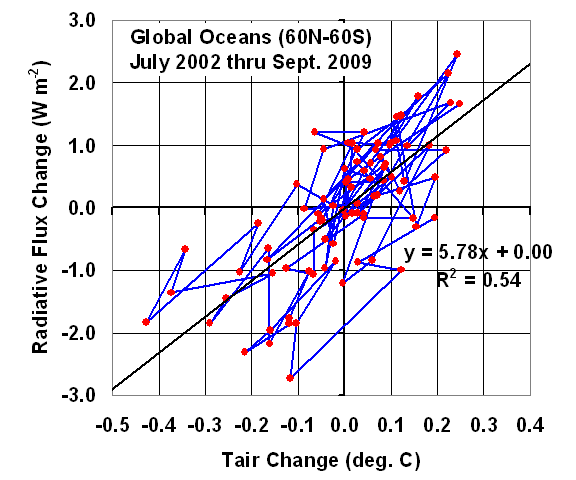
Spencer: strong negative feedback found in radiation budget“. Sometimes denialists proclaim that there is NO GREENHOUSE EFFECT, sometimes they admit that it is REAL BUT SMALL. Dr. Roy Spencer takes the latter approach here. He’s been “slicing and dicing the [Earth’s radiation budget data] different ways” trying to find a value of CO2 sensitivity that lets him claim the climate impact is small. Guess what? He found one.

Dr. Spencer's usual blob of data without chronological context.

Spencer does it “without going into the detailed justification” by:

  • Ignoring data from polar areas, where most of the climate change has occurred.
  • Comparing global radiation data to ocean temperatures.
  • Pretending that 7 years of satellite data is a sufficient time span for climate analysis (try 30 years).
  • Restricting his plot to just month-to-month variation.
  • Using only monthly temperature changes that were greater than 0.03°C.
  • Ignoring decades of independent empirical studies that conclude that climate sensitivity must be somewhere between 2.3 to 4.1°C.
  • Sweeping away the 0.6°C warming over last 100 years as natural (therefore a similar estimated rise for this century must also be natural).
  • Ignoring the reality check that ice ages are impossible if CO2 sensitivity is as low as he declares.

What does Dr. Spencer end up with? I mean besides the WUWT comments declaring him a shoo-in for a Nobel Prize. He ends up with an artificial statistical correlation with no physical explanation to support it.

Predictions Of Global Mean Temperatures & IPCC Projections

Predictions Of Global Mean Temperatures & IPCC Projections“. A guest post by Girma Orssengo “B. Tech, MASc, PhD”. He’s created a mathematical model that predicts global cooling by about 0.42 deg C by 2030. Good work! Take the rest of the day off, everyone.

Uh oh, he doesn’t even know the name of the institution whose temperature data he has used. What is the “Climate Research Unit (CRU) of the Hadley Center”? CRU is part of the University of East Anglia. The Hadley Centre is part of the Meteorological Office.

Left unmentioned is the critical mechanism behind his “mathematical model”. What drives all this? I vote for mermaids. Wait, make that pirates. Or… pirates and mermaids, working together.

Update 2010/05/13: I must have rushed this post, here’s Dr. Orssengo’s evidence in chart form:

Not a great fit or even a prediction of declining temperature. Source: WUWT.

Airlines Blame Flawed Computer Modelling For Up To $1.7 Billion Loss

Airlines Blame Flawed Computer Modelling For Up To $1.7 Billion Loss“. Anthony Watts rounds up some like-minded comments about the impact of the Eyjafjallajokull volcano eruption. Apparently gubmints are ruining everything and computer models are all flawed.

The IATA, a lobby group for the airline industry, would have preferred to roll the dice and keep flying through the ash clouds from the Eyjafjallajokull volcano in Iceland. The astroturf Global Warming Policy Foundation says ‘right on, them gubmits can’t tell us what to do!’

The GWFP is actually just co-opting this topic to declare that they want “to bring reason, integrity and balance to a climate debate that has become seriously unbalanced, irrationally alarmist, and all too often depressingly intolerant”. We have to “balance between risk and reward“, in this instance, the airline’s profits versus their passenger’s lives. Just like coal and oil company profits have to be ‘balanced’.

The dangers of flying through an ash cloud. Source: BBC News.

What’s happening in the air? The criticized Numerical Atmospheric-dispersion Modelling Environment (NAME) has been updated with new safety thresholds based on better detection and risk assessments. Commercial flight has resumed with much smaller “no-fly” zones.

Denialists are trying to paint this as another example of a computer modeling failure, but the system, which accurately modeled the ash dispersion, has simply been updated with better risk analysis.